Last updated: October 16, 2026. This guide is for general information and is not medical advice. Air quality changes hour by hour, so check a live source before you plan outdoor activity, and speak to a doctor about your own health needs.
Introduction: AQI Explained in Simple Words
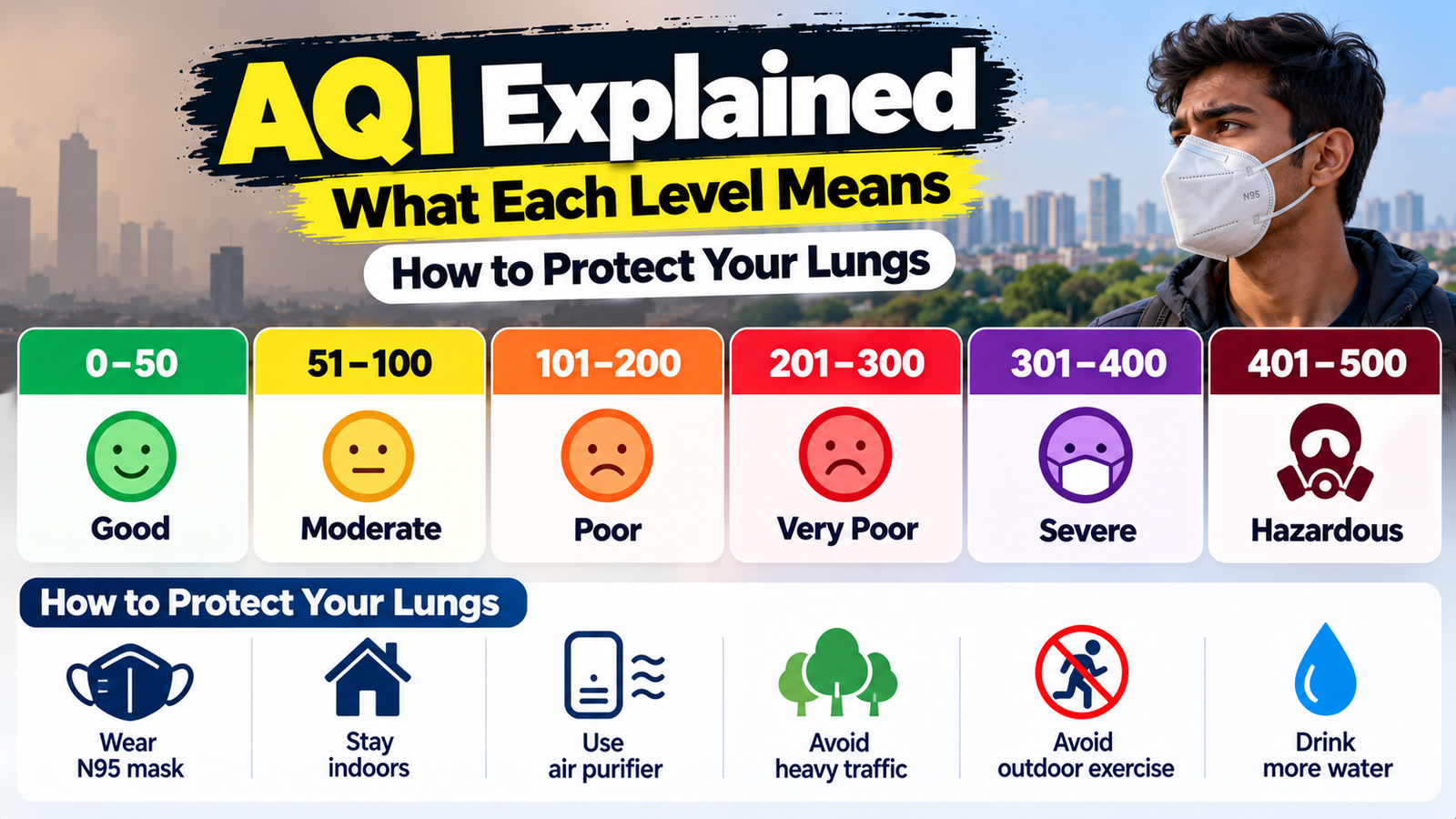
AQI explained simply is a number that tells you how clean or polluted the air is and what that means for your health. The higher the number, the more polluted the air. In north India the winter pollution season has already started: on the morning of 16 October 2026 a real-time tracker showed Delhi at 164 on the US AQI scale, which falls in the Unhealthy range, and the worst reading in the previous 24 hours was 201.
This AQI explained guide covers what each level means, why different apps show different numbers, how to protect your lungs with masks and indoor air tips, and when to see a doctor.
Table of Contents
Quick Answer
- AQI explained in short: it is a scale that turns pollution measurements, mainly PM2.5 and PM10, into one number.
- India’s CPCB and the US EPA use different scales, so the same air can show different numbers in different apps.
- On the US scale, 0 to 50 is Good and 151 to 200 is Unhealthy. On the Indian scale, 201 to 300 is Poor.
- When AQI is high, reduce long outdoor exercise, keep windows closed during the worst hours and wear a well-fitted N95 or FFP2 mask outdoors if you must go out.
- Children, older adults, pregnant women and people with asthma, heart or lung disease should be extra careful.
- See a doctor quickly for breathing trouble, chest pain or severe wheezing.
AQI Explained: The Two Scales You Will See
| Level (US EPA scale) | AQI range | Level (India CPCB scale) | AQI range |
|---|---|---|---|
| Good | 0 to 50 | Good | 0 to 50 |
| Moderate | 51 to 100 | Satisfactory | 51 to 100 |
| Unhealthy for Sensitive Groups | 101 to 150 | Moderate | 101 to 200 |
| Unhealthy | 151 to 200 | Poor | 201 to 300 |
| Very Unhealthy | 201 to 300 | Very Poor | 301 to 400 |
| Hazardous | 301 and above | Severe | 401 to 500 |
The two scales are built differently, so do not compare numbers across them. Always check which scale your app uses.
What to Do at Each AQI Level (US Scale)
| AQI level | What it means | What to do |
|---|---|---|
| Good (0 to 50) | Air quality is satisfactory | Normal activity |
| Moderate (51 to 100) | Acceptable, but unusually sensitive people may notice effects | Unusually sensitive people should reduce long, heavy exertion outdoors |
| Unhealthy for Sensitive Groups (101 to 150) | Sensitive groups may be affected | Children, older adults and people with heart or lung disease should reduce long outdoor exertion |
| Unhealthy (151 to 200) | Everyone may start to feel effects | Reduce long outdoor exercise. Sensitive groups should stay indoors more |
| Very Unhealthy (201 to 300) | Health alert | Avoid outdoor exercise. Sensitive groups should stay indoors |
| Hazardous (301 and above) | Emergency conditions | Stay indoors, keep windows closed and use a purifier if you have one |
GRAP in Delhi-NCR: What the Stages Mean
Delhi-NCR uses the Graded Response Action Plan, or GRAP, to bring in emergency measures as air quality worsens. GRAP Stage 1 has been active since 1 October 2026.
| GRAP stage | When it is triggered (Indian AQI) |
|---|---|
| Stage 1 | 201 to 300 |
| Stage 2 | 301 to 400 |
| Stage 3 | 401 to 450 |
| Stage 4 | Above 450 |
Follow the official CAQM orders for rules on construction, vehicles and schools, and check them before planning your commute or classes.
Which Mask Protects You From Polluted Air?
| Mask type | Protection against fine particles (PM2.5) | Note |
|---|---|---|
| Cloth mask | Low | Helps little against fine particles |
| Surgical mask | Limited | Blocks larger droplets but fits loosely |
| N95, KN95 or FFP2 respirator | High when well fitted | Needs a tight seal around the nose and cheeks |
A good mask only works if it fits. Facial hair and gaps at the sides reduce protection. Children need masks made in smaller sizes, so ask a doctor or pharmacist before using one for a young child.
Indoor Air Tips When AQI Is High
With the AQI explained above, use these indoor tips whenever the number is high.
- Keep windows and doors closed during the worst hours, and open them briefly when the AQI is lower.
- Use a HEPA air purifier that is suitable for the size of your room. Avoid purifiers that produce ozone.
- Do not burn incense, candles or mosquito coils indoors, because they add smoke.
- Clean floors with a damp mop instead of dry sweeping, which raises dust.
- Drink enough water, and do not rely on indoor plants to clean the air.
Who Is Most at Risk?
- Children, whose lungs are still developing
- Older adults
- Pregnant women
- People with asthma, COPD, heart disease or diabetes
- People who work or exercise outdoors
If you have asthma or a heart condition, follow the plan your doctor gave you and keep your medicines with you.
When to See a Doctor
| Symptom | What to do |
|---|---|
| Eye, nose or throat irritation, mild cough | Reduce exposure, rest and drink water. See a doctor if it does not improve |
| Cough or wheezing that keeps getting worse | See a doctor soon |
| Shortness of breath, chest pain or tightness | Get medical help urgently |
| Blue lips, severe breathing difficulty or confusion | Call emergency services immediately |
Final Thoughts on AQI Explained
Now that you have AQI explained in simple terms, the most useful habit is to check a live reading each morning, match it to the right scale and change your plans when the number rises. A well-fitted N95 mask, a closed room and a HEPA purifier can reduce your exposure, but a doctor is the right person for health concerns.
Frequently Asked Questions
What is AQI explained in one line?
AQI is a number from 0 upward that shows how polluted the air is, and higher numbers mean greater health risk.
Why do different apps show different AQI numbers?
They may use different scales (US EPA or India CPCB), different sensors and different averaging times.
Is AQI 150 safe?
On the US scale, 101 to 150 is unhealthy for sensitive groups, so children, older adults and people with lung or heart disease should reduce long outdoor exertion.
Do masks and air purifiers really help?
A well-fitted N95, KN95 or FFP2 mask can reduce your exposure to fine particles, and a HEPA purifier can lower indoor particles. Neither replaces medical care.
Should I exercise outside when the AQI is high?
It is better to avoid heavy outdoor exercise at Unhealthy levels and above. Choose indoor exercise instead.
Update Log
| Date | Update |
|---|---|
| October 16, 2026 | First version based on CPCB and US EPA AQI categories and current Delhi-NCR reports |
Sources and Official Links
- Central Pollution Control Board (CPCB)
- Commission for Air Quality Management (CAQM)
- AirNow: AQI basics
- World Health Organization: air pollution
- AQI.in: live Delhi air quality
Related Guides
Breathing trouble this season? See our guides to cold vs flu vs COVID symptoms and how to recover from cold or flu at home.


Leave a Reply