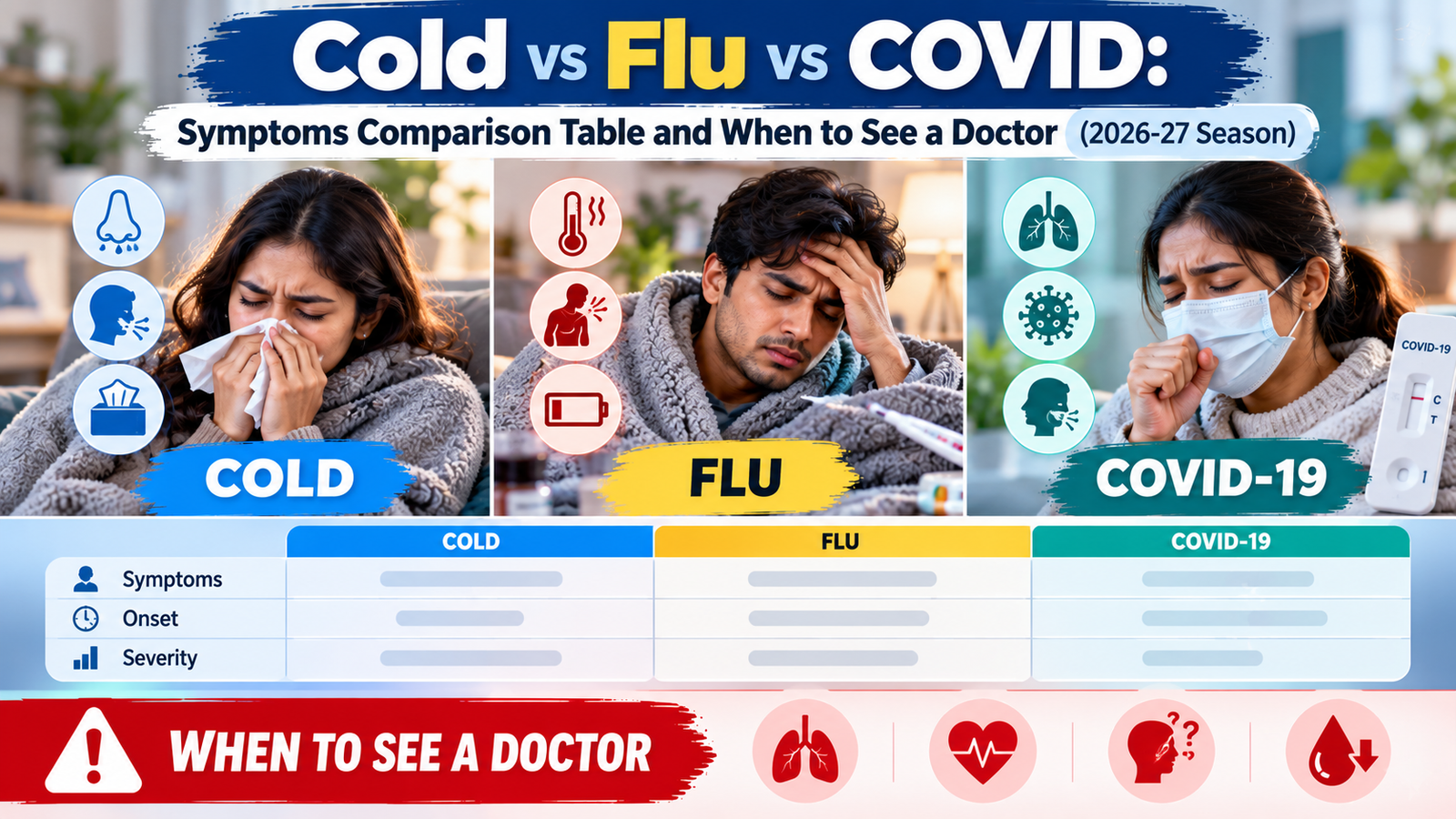
Last updated: October 9, 2026. This guide is general health information, not a diagnosis or medical advice. Symptoms overlap, and a test is the only reliable way to tell these illnesses apart. If you are worried, or if you or someone you care for is in a high-risk group, contact a doctor. In an emergency, call your local emergency number.
Introduction: Why Cold, Flu and COVID Are Hard to Tell Apart
As autumn turns to winter, many people get a cough, sore throat or fever and wonder whether it is a cold, the flu or COVID-19. All three are respiratory infections caused by different viruses. Their symptoms overlap, which is why doctors usually recommend testing instead of guessing.
This guide gives you a comparison table, a list of the clues that help, advice on testing and treatment timing, red-flag signs that need urgent care, and when to isolate. The viruses that circulate change from season to season, so check your national health agency for current local information during the 2026-27 season.
Quick Answer
- Colds are usually milder and centered on a runny or stuffy nose, sneezing and sore throat, and they build up gradually.
- Flu often hits suddenly with fever, chills, body aches and exhaustion.
- COVID-19 can look like a cold or flu. Loss of taste or smell is more typical of COVID, though less common than in earlier waves.
- Testing is the only reliable way to tell flu and COVID apart. Rapid tests for both are widely available.
- Get urgent care for trouble breathing, chest pain or pressure, confusion, bluish lips or face, or symptoms that get better and then suddenly worsen.
Symptom Comparison Table
This table shows what is typical. Anyone can have a milder or different set of symptoms, and vaccination or past infection can change how illness feels.
| Feature | Common cold | Flu (influenza) | COVID-19 |
|---|---|---|---|
| Onset | Gradual, over a day or two | Sudden, often within hours | Can be sudden or gradual |
| Fever | Uncommon or mild | Common, often high | Common, can be low-grade |
| Chills | Uncommon | Common | Common |
| Body aches | Mild, if any | Common and often severe | Common |
| Fatigue | Mild | Common and can be intense | Common; may last longer |
| Runny or stuffy nose | Very common | Sometimes | Common |
| Sneezing | Common | Sometimes | Less common |
| Sore throat | Common, often first | Sometimes | Common, often an early sign |
| Cough | Mild to moderate | Common, usually dry | Common; can persist for weeks |
| Headache | Sometimes | Common | Common |
| Loss of taste or smell | Rare | Rare | More typical than in cold or flu, but less common than before |
| Nausea, vomiting or diarrhea | Rare | Sometimes, more in children | More common than in flu |
| Shortness of breath | Uncommon | Can occur in severe cases | Can occur; a warning sign |
| How soon symptoms appear after exposure | 1 to 3 days | About 1 to 4 days | About 2 to 14 days |
| Typical length | About 7 to 10 days | About 3 to 7 days; cough and tiredness may last longer | Varies; mild cases often 1 to 2 weeks, cough or fatigue can last longer |
Clues That Can Help
| If you notice… | It could point to… | What to do |
|---|---|---|
| Stuffy nose and sneezing, mild sore throat, no fever | A common cold | Rest, fluids and symptom relief. Test if you were exposed or are high-risk. |
| Sudden high fever, chills, aching muscles and exhaustion | Flu or COVID-19 | Take a COVID and flu test. Contact a doctor early if you are high-risk. |
| Sore throat and congestion, with a mild or changing fever | Cold or COVID-19 | Take a COVID test and repeat it after about 48 hours if the first is negative. |
| New loss of taste or smell | COVID-19 is more likely | Take a COVID test and avoid contact with others. |
| Fever plus a cough that lingers for weeks | COVID-19, flu or another infection | See a doctor if it does not improve. |
| Stomach upset with fever and cough in a child | Flu or COVID-19, or another illness | Watch for dehydration; ask a doctor. |
Testing: What, When and Why
- Rapid home tests are available for COVID-19, and combined tests that check for flu A, flu B and COVID-19 are also sold in many countries.
- Test when you have symptoms, and if the first test is negative but you are still ill, repeat it after about 48 hours.
- A lab or clinic test is more sensitive and can also check for other viruses such as RSV.
- Testing matters most if you are in a high-risk group, live with someone who is, or may qualify for antiviral medicine.
Why Timing Matters: Antiviral Medicines
Prescription antivirals exist for both flu and COVID-19, but they work best when started early.
| Illness | Antiviral treatment | Best started within |
|---|---|---|
| Flu | Prescription antivirals such as oseltamivir (Tamiflu) | 48 hours of the first symptoms, though doctors may still treat later in severe illness or high-risk patients |
| COVID-19 | Prescription antivirals for eligible people at higher risk | A few days of symptoms; in the United States, within 5 days |
| Common cold | None specific | Rest and symptom relief |
Antibiotics do not work against colds, flu or COVID-19, because they are caused by viruses. Do not ask for antibiotics unless a doctor finds a bacterial complication.
Who Is at Higher Risk?
- Adults aged 65 and older.
- Babies and young children, especially under 2 years.
- Pregnant people and those who have recently given birth.
- People with chronic conditions such as asthma, heart disease, diabetes or kidney disease.
- People with weakened immune systems.
- People with obesity or other long-term health conditions.
If you or someone in your household is in a high-risk group, contact a doctor early when symptoms start, so you can ask about testing and treatment.
Red-Flag Signs: When to Get Urgent Medical Help
Adults
- Trouble breathing or shortness of breath.
- Chest pain or pressure that does not go away.
- New confusion or difficulty waking up.
- Bluish or gray lips, face or nails.
- Severe or persistent vomiting, or signs of dehydration such as very little urine.
- Fever that does not come down, or symptoms that get better and then return worse.
- Worsening of a chronic condition such as asthma or heart disease.
Children
- Fast or difficult breathing, or ribs pulling in with each breath.
- Bluish skin or lips.
- Not drinking enough fluids, no tears or very few wet diapers.
- Unusual sleepiness, trouble waking up or not interacting.
- Severe irritability, or a child who does not want to be held.
- Fever in a baby younger than 3 months (38 degrees C or 100.4 degrees F or higher). Contact a doctor right away.
Call your local emergency number or go to the nearest emergency department for any of the signs above if they are severe.
Should You Stay Home or Isolate?
Public health guidance differs by country and changes over time, so check your health agency’s current advice. In the United States, CDC guidance for respiratory viruses is a useful example:
- Stay home until your symptoms are getting better overall and you have been fever-free for at least 24 hours without fever-reducing medicine.
- Then take extra precautions for the next several days, such as masking around others, washing hands often, improving ventilation and avoiding people at high risk.
- Tell close contacts if you test positive for flu or COVID-19, especially anyone at higher risk.
Prevention: What Helps
| Action | How it helps |
|---|---|
| Annual flu vaccine | Lowers the risk of flu and of serious illness; effectiveness varies by season |
| COVID-19 vaccination as recommended in your country | Lowers the risk of severe illness |
| Other vaccines such as RSV for eligible groups | Protects older adults and infants where recommended |
| Hand washing with soap and water | Removes germs that spread colds and other infections |
| Fresh air and ventilation | Reduces the concentration of virus in indoor air |
| Staying home when ill | Prevents spreading to others |
| Masks in high-risk situations | Can reduce spread, especially in crowded indoor places |
Ask your doctor or pharmacist which vaccines are recommended for you in the 2026-27 season.
Cold, Flu and COVID: Quick Scenarios
| Scenario | What it might be | Sensible next step |
|---|---|---|
| You wake up with a scratchy throat and a runny nose, and feel fine otherwise | Probably a cold | Rest and fluids; test if you were exposed |
| You feel fine in the morning and have a high fever and aches by evening | Possibly flu or COVID-19 | Test now; contact a doctor if high-risk |
| You lost your sense of smell and have a mild cough | COVID-19 is more likely | Test and stay home |
| Your child has a fever, cough and vomiting | Flu, COVID-19 or another infection | Watch fluids and call a doctor if worried |
| You are 70 and have a fever and feel breathless | Possibly serious illness | Seek urgent medical advice |
Common Myths
| Myth | Fact |
|---|---|
| A bad cold is the flu | A very bad cold can feel awful, but flu is a different virus and usually hits faster and harder |
| You can tell COVID from the flu by symptoms alone | Symptoms overlap too much. Test to be sure. |
| Antibiotics help with viral infections | They do not. They only treat bacterial infections. |
| If you had the flu shot, you cannot get flu | You can still get flu, but the shot lowers the chance of severe illness |
| You do not need a test if you feel okay | Testing helps protect others, especially people at high risk |
Frequently Asked Questions
How can I tell flu from COVID-19 at home?
You often cannot tell by symptoms alone. A home test for both viruses is the best way to find out.
How long are you contagious?
People can spread these viruses a day or so before symptoms and for several days after. Follow your health agency’s guidance on when it is safe to be around others.
Can you have two infections at the same time?
Yes. People can be infected with more than one virus at once, which is why a combined test or a doctor’s advice can help.
When should I see a doctor?
See a doctor if you are in a high-risk group, if symptoms are severe or last longer than expected, or if you have any red-flag signs listed above.
How do I care for myself at home?
Rest, drink fluids and treat symptoms. See our guide to how to recover from a cold or flu at home.
Update Log
| Date | Update |
|---|---|
| October 9, 2026 | First version for the 2026-27 season, using general guidance from public health agencies and health systems |
Sources and Official Links
Related Guides
Next, read How to recover from a cold or flu at home. For steadier everyday health, see metabolic health for beginners.


Leave a Reply