Last updated: October 9, 2026. This guide is general health information, not a diagnosis or medical advice. Scrub typhus needs a doctor’s diagnosis and prescription antibiotics. Do not treat yourself. If you or someone you care for has a fever and has been in grass, scrub or forest areas, see a doctor soon. In an emergency, call your local emergency number.
Introduction: What Is Scrub Typhus and Why Is It in the News in 2026?
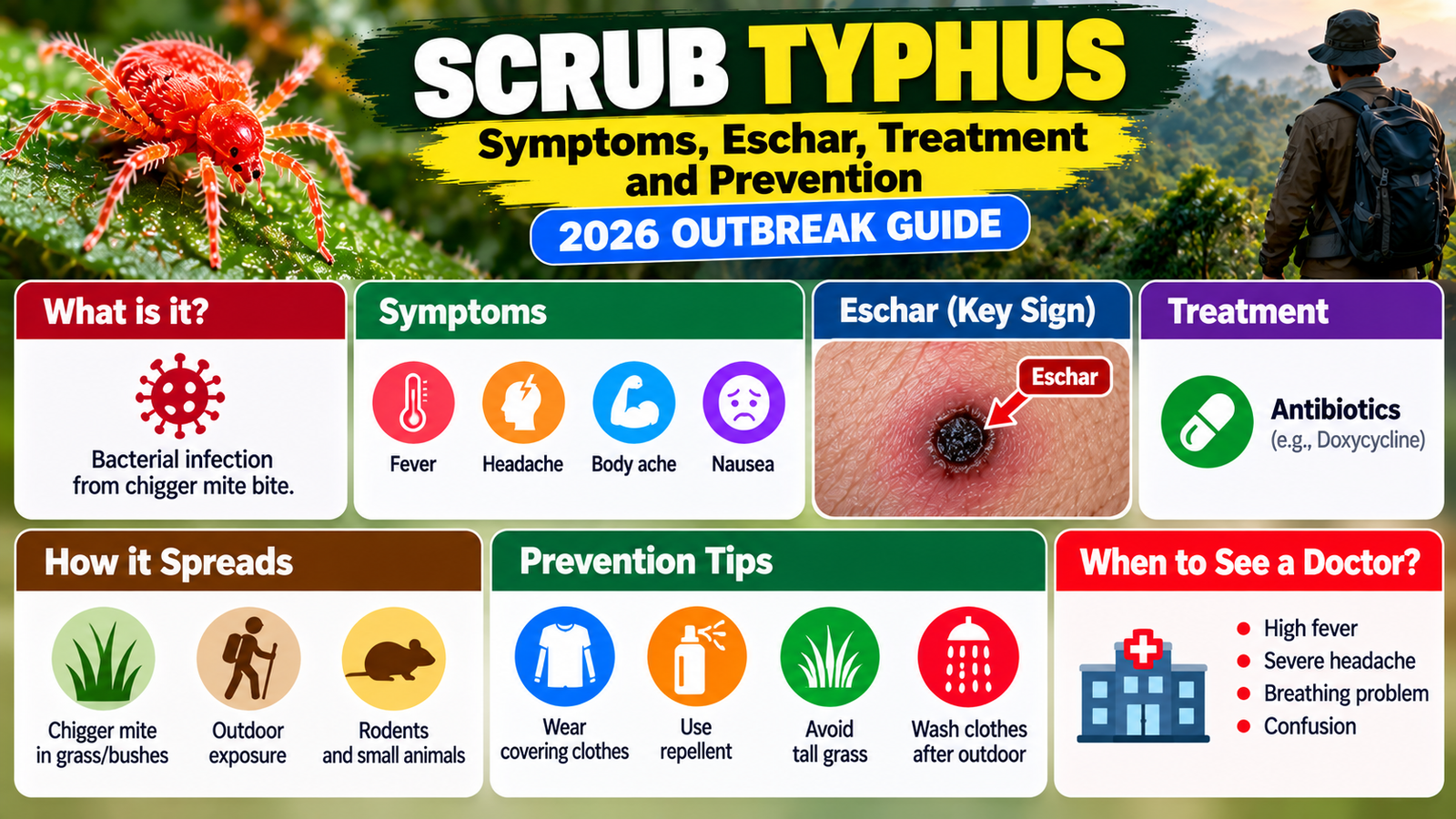
Scrub typhus is a bacterial infection caused by Orientia tsutsugamushi. It spreads through the bite of infected chigger mites (the larval stage of certain mites), which live in grass, scrub and forest edges, often in places where rodents are found. It is also called bush typhus. It is common across South and Southeast Asia, parts of China and Japan, and northern Australia, and it can be treated with antibiotics when found early.
In 2026, health authorities in several places have reported higher-than-usual numbers. Nepal has recorded over 10,000 cases this year, with a sharp rise during the monsoon and after it, and Taiwan reported more cases by early July than in the same period of recent years. This guide explains symptoms, the eschar, how it is diagnosed, treatment, prevention, and when to seek urgent care.
Quick Answer
- Cause: a bacterium spread by the bite of infected chigger mites. It does not spread from person to person.
- Symptoms: fever, chills, severe headache, body aches, tiredness, and sometimes a rash, swollen glands and cough, starting about 1 to 3 weeks after a bite.
- The eschar is a painless black, scab-like sore at the bite site. It is a helpful clue, but many patients do not have one, so its absence does not rule scrub typhus out.
- Treatment: doctors usually prescribe the antibiotic doxycycline, and other antibiotics in some groups. It works best when started early, and many people improve within one to three days.
- Prevention: avoid chigger-prone vegetation, cover skin, use repellent, wash clothes and shower after exposure. There is no vaccine.
- Get medical help early for fever lasting more than a few days after outdoor exposure, and urgently for breathing trouble, confusion, bleeding or very little urine.
2026 Outbreak Snapshot
These numbers come from health authority reports published in news coverage in early October 2026, and may be revised.
| Place | What was reported | Source type |
|---|---|---|
| Nepal (national) | 10,210 cases across 74 districts in the first 40 epidemiological weeks of 2026, and 7 verified deaths in an earlier situation report covering the period to 1 October | Epidemiology and Disease Control Division (EDCD), reported by Himalayan Times |
| Nepal (monthly trend) | 1,342 cases in July, 2,571 in August and 2,746 in September 2026, higher than the same months in 2024 and 2025 | EDCD situation reports |
| Nepal (regions) | Lumbini recorded the most cases; Gandaki had the highest rate at 78.5 per 100,000 people | EDCD, reported by Himalayan Times |
| Salyan, Nepal | An outbreak that began in July in Darma Rural Municipality was still spreading in early October, with health camps and testing under way | Kathmandu Post |
| Taiwan | 104 confirmed cases by 1 July 2026, higher than the same period in 2023 to 2025 | Taiwan CDC (via a hospital notice) |
| India | Cases occur every year in many states, often in the rainy and post-monsoon months, and some state health departments have issued advisories in recent years | Health department advisories and studies |
Nepal’s health authority says treatment is available free of charge at government health institutions and has listed the toll-free helpline 1115. If you live elsewhere, check your own health department’s advisories.
How Scrub Typhus Spreads
- Chigger mites hatch in soil and vegetation. Their larvae attach to skin and feed on tissue fluid. Some carry the bacteria from infected rodents.
- You may not notice the bite. Chiggers are tiny and the bite is often painless or only mildly itchy.
- Common bite areas are skin folds and places where clothing is tight, such as the waist, armpits, groin, behind the knees and under the breasts.
- It is not contagious. You cannot catch it from someone who is ill.
- Higher-risk activities: farming, harvesting, herding, collecting firewood, camping, trekking, military training and walking through scrub.
Timeline: From Bite to Illness
| Stage | When | What happens |
|---|---|---|
| Bite | Day 0 | A chigger feeds on the skin, often unnoticed |
| Early skin changes | Days 1 to 7 | A small red bump may form and sometimes turns into an eschar |
| Incubation | About 6 to 21 days after the bite | The bacteria multiply; there may be no symptoms |
| Illness begins | Usually in week 1 to 3 | Fever, chills, headache, body aches and fatigue |
| Without treatment | Second week onward | Risk of lung, brain, kidney, liver or heart complications |
| With doxycycline | Often within 24 to 72 hours | Fever and symptoms commonly begin to settle |
Symptoms of Scrub Typhus
| Symptom | How common or typical | Notes |
|---|---|---|
| Fever and chills | Very common | Often high and persistent |
| Severe headache | Very common | Can be intense |
| Muscle and body aches | Common | May feel like flu |
| Fatigue and weakness | Common | Can be extreme |
| Eschar (dark, scab-like bite site) | Present in some patients, often a minority in South Asian studies, and more common in others | Painless; helpful clue when found |
| Rash | Reported in a minority of patients | May appear on the trunk or limbs |
| Swollen lymph nodes | Common in some series | Often near the bite |
| Cough or breathing difficulty | Can occur | May signal lung involvement |
| Nausea, vomiting, belly pain or diarrhea | Can occur | May mimic other fevers |
| Red eyes | Listed in some health advisories | Not specific |
| Confusion or drowsiness | In severe cases | Seek urgent care |
Scrub typhus often looks like dengue, malaria, typhoid or other fevers, which is why it is under-diagnosed in some areas.
The Eschar: What It Looks Like and Where to Find It
- A painless, dark brown or black scab-like crust, often with a red border, and sometimes surrounded by redness.
- Usually a single lesion, about a few millimeters to a couple of centimeters across.
- Often found in hidden places: armpits, groin, waist, chest, back, behind the knees, neck and genital area.
- It does not hurt or itch much, so many people never notice it.
- Check your whole body (or ask a doctor to check) if you have an unexplained fever after outdoor exposure.
Studies from India have found an eschar in only a small share of patients, sometimes below 15%, while studies in other settings report it more often. An eschar strongly suggests scrub typhus, but its absence does not exclude the disease.
Diagnosis
| Test or approach | What it does | Notes |
|---|---|---|
| Medical history and exam | Looks for outdoor exposure, fever pattern and an eschar | Often the first clue, especially in endemic areas |
| IgM ELISA blood test | Detects antibodies to the bacterium | Widely used; may be negative very early |
| PCR test | Detects the bacterium’s genetic material | More useful early in illness; not available everywhere |
| Other blood tests and imaging | Checks liver, kidneys, blood counts and lungs | Helps judge severity and rule out other causes |
| Treatment on suspicion | Doctors may start antibiotics before results | Reasonable in endemic areas because early treatment matters |
If your first test is negative but you remain unwell, ask your doctor whether it should be repeated.
How Scrub Typhus Differs From Look-Alike Illnesses
Only tests can tell these apart. This table lists clues doctors consider, not a way to diagnose yourself.
| Illness | Similar features | Clues that may differ |
|---|---|---|
| Dengue | Fever, headache, body ache, rash | Often joint and eye pain, low platelets, mosquito exposure |
| Malaria | Fever and chills | Cyclical fevers in some types; mosquito exposure; blood smear or rapid test |
| Typhoid (enteric fever) | Prolonged fever, headache, belly symptoms | Often slower build-up; blood culture or other tests |
| Leptospirosis | Fever, muscle pain, red eyes | Exposure to flood water or animal urine; calf tenderness |
| Flu or COVID-19 | Fever, aches, cough | Respiratory outbreaks; tests for those viruses |
| Other rickettsial fevers | Fever, rash, eschar in some | Tick or flea exposure; similar treatment |
Treatment
- Doxycycline is the usual first-choice antibiotic for scrub typhus in adults and, under medical advice, in children. It works best if started early.
- Other antibiotics, such as azithromycin, may be used in pregnancy or other situations at a doctor’s discretion.
- Many people improve within one to three days of starting the right antibiotic, but you must finish the full course your doctor prescribes.
- Severe illness may need hospital care, oxygen, fluids, intensive care or treatment for organ complications.
- Do not self-medicate. Antibiotic choice and dose depend on age, weight, pregnancy, other medicines and kidney or liver health.
- Rest and fluids help recovery, and fever medicines may be advised by your doctor.
Why Delay Is Dangerous
If scrub typhus is not treated, it can spread through the small blood vessels and affect several organs. Possible complications include pneumonia or lung injury, inflammation of the brain or its lining, kidney failure, liver injury, heart inflammation, low blood pressure and multi-organ failure. Most people recover fully with timely treatment, which is why doctors in endemic areas often start antibiotics for people with long, unexplained fever.
Red-Flag Signs: When to Get Urgent Care
- Difficulty breathing, fast breathing or chest pain.
- Confusion, severe drowsiness, seizures or a severe headache with a stiff neck.
- Very little or no urine, or severe vomiting that stops you drinking.
- Bleeding, black stools or bruising.
- Yellowing of the skin or eyes.
- Fainting, cold clammy skin or a very fast heartbeat.
- Fever in pregnancy, a young child or an older adult that is not improving.
Call your local emergency number or go to the nearest hospital for these signs.
Who Is at Higher Risk?
| Group | Why |
|---|---|
| Farmers, herders and forest workers | Frequent contact with vegetation and rodents |
| Hikers, campers and trekkers | Exposure in grass and scrub |
| Rural residents with rodents near homes | Mites live near rodent habitats |
| Military trainees | Outbreaks have been reported in field training |
| Pregnant people | Need careful treatment choices |
| Young children and older adults | May become severely ill faster |
| People with chronic illnesses | May have more complications |
Prevention
| When | What to do |
|---|---|
| Before going outdoors | Wear long sleeves, long trousers tucked into socks and closed shoes. Apply an insect repellent such as DEET or picaridin to skin and clothing as directed on the label. Consider clothing treated with permethrin. |
| While outdoors | Avoid sitting or lying on bare grass or leaf litter; use a groundsheet or raised seat. Stay on cleared paths and avoid brushing against vegetation. |
| After outdoors | Change clothes, wash them in hot water if possible, shower soon afterwards and check skin folds for bites or a new dark sore. |
| At home and in the community | Keep grass and bushes cut short around homes, store grain and food so rodents are not attracted, keep rubbish managed and use safe rodent control methods. |
| In outbreak areas | Follow local health department advice, attend health camps and seek early testing for fever. |
- There is no vaccine for scrub typhus.
- Preventive antibiotics are not for the general public. In rare high-risk situations they may be considered only on medical advice.
- Children should wear covered clothing during outdoor play in endemic areas, and parents should check skin folds after play.
Myths and Facts
| Myth | Fact |
|---|---|
| If there is no eschar, it is not scrub typhus | Many patients have no eschar |
| It spreads from person to person | It does not. It spreads through chigger bites. |
| Chiggers burrow into skin and live under it | They attach to the skin to feed and then drop off |
| Any antibiotic will work | Doxycycline and some others work; many common antibiotics do not |
| It is only a rural problem | Rural exposure is most common, but anyone entering infested areas can be bitten |
| Fever medicines alone are enough | Fever medicines ease symptoms, but they do not treat the infection |
What to Do If You Suspect Scrub Typhus
- Note your exposure: where you were, when, and what you did (farming, trekking, camping).
- Check your skin for an eschar or unusual bumps, including skin folds.
- See a doctor and tell them about the outdoor exposure and fever duration.
- Ask whether scrub typhus testing is needed if you have a fever of several days without a clear cause.
- Follow the treatment exactly, and return if you are not improving in a couple of days.
- Warn others in your household or group who share the exposure, so they can watch for symptoms.
Frequently Asked Questions
Is scrub typhus dangerous?
It can be serious if untreated, but most people recover with timely antibiotics. Deaths have been reported in outbreaks, which is why early care matters.
How long does it take to recover?
Fever often settles within a few days of starting the right antibiotic, but tiredness can last longer. Severe cases take longer.
Can you get scrub typhus more than once?
Yes. Immunity is not reliable, and different strains exist, so repeat infections are possible.
Can children get scrub typhus?
Yes. It is a recognized cause of fever in children in affected regions. Children need prompt medical assessment.
Should I take antibiotics at home if I have fever?
No. Self-treatment can hide symptoms, cause side effects and delay a proper diagnosis. See a doctor.
Update Log
| Date | Update |
|---|---|
| October 9, 2026 | First version using CDC guidance, clinical studies and health authority reports on the 2026 outbreak |
Sources and Official Links
- CDC: About scrub typhus
- World Health Organization
- National Centre for Disease Control, India
- Nepal Epidemiology and Disease Control Division
- The Himalayan Times: Nepal scrub typhus case reports
- The Kathmandu Post: Salyan outbreak report
- PubMed Central: clinical studies of scrub typhus in India
Related Guides
For general fever care, read how to recover from a cold or flu at home and compare symptoms in cold vs flu vs COVID.



Leave a Reply