
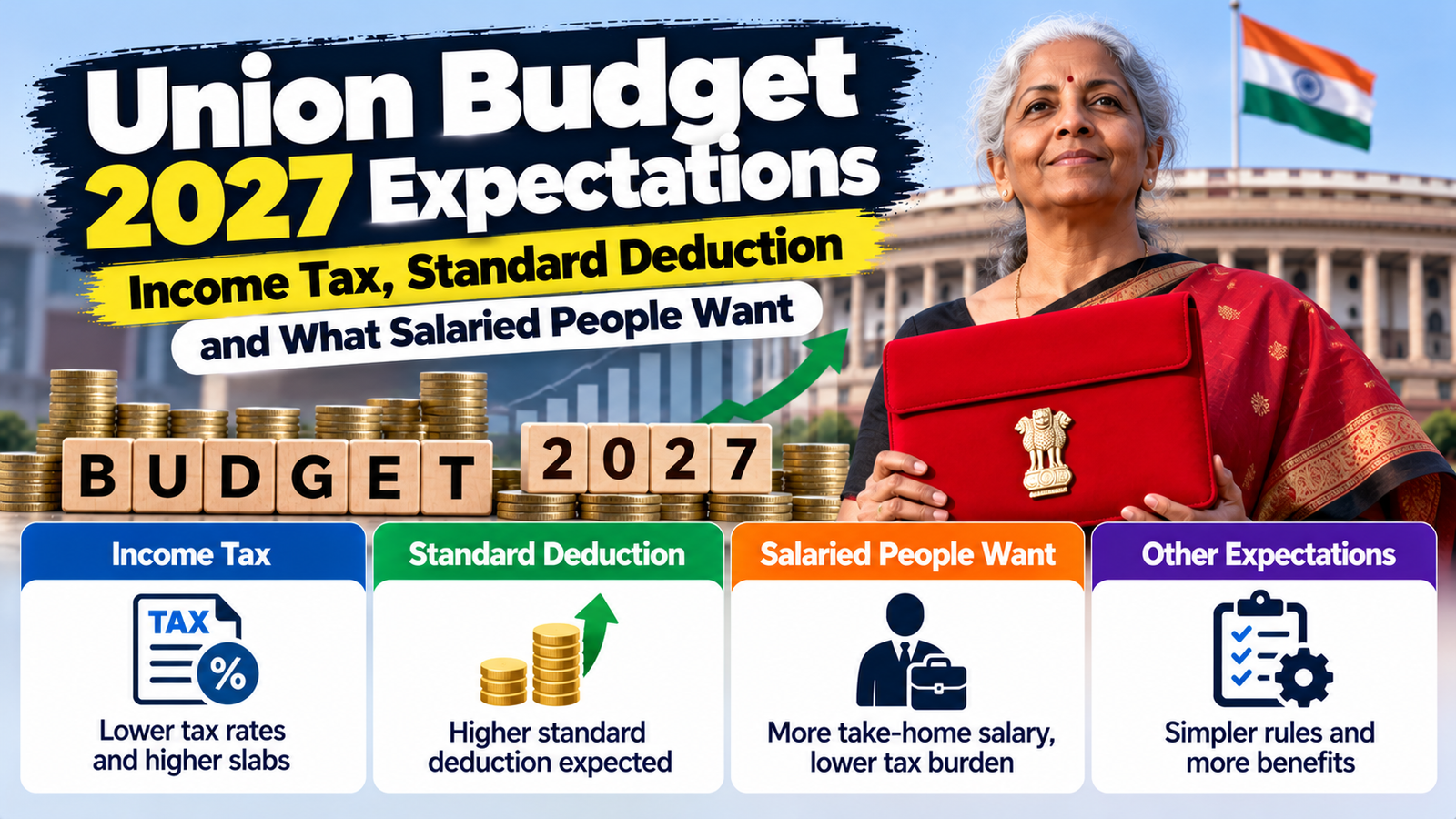
Last updated: October 23, 2026. This guide explains current income tax rules and the wish lists that taxpayers commonly raise. The date and contents of Budget 2027 have not been announced, so nothing here is a prediction or a government plan. This is not tax advice.
Introduction: Union Budget 2027 Expectations, What We Know and What We Do Not
Union Budget 2027 expectations are already building among salaried taxpayers, but nothing about the next Budget has been announced. The Budget is usually presented on 1 February, and the date for 2027 has not been confirmed. The last Budget, presented on 1 February 2026, kept income tax slabs, the standard deduction and the Section 87A rebate unchanged.
This guide to Union Budget 2027 expectations covers the current rules, a tax table you can use today, the items taxpayers commonly ask for, what a change could be worth in rupees (as an illustration, not a forecast) and how to plan while you wait.
Table of Contents
Quick Answer
- Confirmed: there is no official announcement about the contents of Budget 2027, and the date is not yet announced. Budgets are usually presented on 1 February.
- Current rules (new regime, FY 2026-27): income up to ₹4 lakh is not taxed, the standard deduction for salaried taxpayers is ₹75,000, and taxable income up to ₹12 lakh is effectively tax-free because of the Section 87A rebate.
- Old regime: the standard deduction is ₹50,000.
- The new Income Tax Act, 2025 took effect on 1 April 2026.
- Do not delay financial decisions in the hope of a specific change.
Current Income Tax Slabs (New Regime, FY 2026-27)
| Taxable income | Tax rate |
|---|---|
| Up to ₹4 lakh | Nil |
| ₹4 lakh to ₹8 lakh | 5% |
| ₹8 lakh to ₹12 lakh | 10% |
| ₹12 lakh to ₹16 lakh | 15% |
| ₹16 lakh to ₹20 lakh | 20% |
| ₹20 lakh to ₹24 lakh | 25% |
| Above ₹24 lakh | 30% |
Taxpayers with taxable income up to ₹12 lakh can claim a rebate of up to ₹60,000 under Section 87A, so they pay no tax. Budget 2026 left these figures unchanged. A health and education cess of 4% applies on the tax payable.
Tax at Current Rules: Salaried Examples
The table shows the new regime with the ₹75,000 standard deduction and no other deductions.
| Gross salary | Taxable income | Tax including 4% cess |
|---|---|---|
| ₹9 lakh | ₹8.25 lakh | ₹0 (rebate) |
| ₹12.75 lakh | ₹12 lakh | ₹0 (rebate) |
| ₹15 lakh | ₹14.25 lakh | ₹97,500 |
| ₹20 lakh | ₹19.25 lakh | ₹1,92,400 |
| ₹30 lakh | ₹29.25 lakh | ₹4,75,800 |
These are illustrations. Your own tax can differ because of other deductions, income from other sources and marginal relief, so use the official Income Tax Department calculator or ask a tax professional.
What Salaried Taxpayers Commonly Ask For
These are items that taxpayers often raise before a Budget. They are not announced plans.
| Common wish | Why taxpayers raise it | Current status |
|---|---|---|
| Higher standard deduction | It lowers taxable income for every salaried person | ₹75,000 (new regime) and ₹50,000 (old regime), unchanged in Budget 2026 |
| Lower rates or wider middle slabs | Living costs have risen | Slabs were unchanged in Budget 2026 |
| Higher Section 80C limit (old regime) | The limit has stayed the same for many years | No announcement |
| More relief for health insurance and home loan interest | Premiums and loan costs have risen | No announcement |
| Simpler rules and forms | Fewer errors and easier filing | New Income Tax Act in force since 1 April 2026 |
What Could a Change Be Worth? (Illustration Only)
Suppose the standard deduction were raised by ₹25,000. This is a hypothetical example, not a prediction. The yearly saving would depend on your top slab:
| Your top slab | Tax saved before cess | Tax saved with 4% cess |
|---|---|---|
| 5% | ₹1,250 | ₹1,300 |
| 10% | ₹2,500 | ₹2,600 |
| 15% | ₹3,750 | ₹3,900 |
| 20% | ₹5,000 | ₹5,200 |
| 25% | ₹6,250 | ₹6,500 |
| 30% | ₹7,500 | ₹7,800 |
If your taxable income is already within the ₹12 lakh rebate limit, you pay no tax, so a higher deduction would not save you anything extra.
How to Plan While You Wait
- Plan this year’s tax using the current rules for FY 2026-27, not rumours.
- Keep regular tax-saving decisions on their normal schedule.
- Remember that a Budget change usually applies from the next financial year, so check the effective date once it is announced.
- Follow official sources such as the Ministry of Finance, the Income Tax Department and PIB.
- Ignore social media posts that claim to know the Budget before it is presented.
Final Thoughts on Union Budget 2027 Expectations
The Union Budget 2027 expectations are still only expectations. The current rules are clear, the date and contents of the Budget are not announced, and the best plan is to use today’s rules for today’s decisions. We will update this guide once the Budget date and announcements are official.
Frequently Asked Questions
What are the Union Budget 2027 expectations for salaried people?
Common wishes include a higher standard deduction, lower rates in the middle slabs and more relief for insurance and home loan interest. None of these has been announced.
When is the Union Budget 2027?
The date has not been announced. Budgets are usually presented on 1 February.
Will income tax slabs change in Budget 2027?
There is no announcement. Budget 2026 left the slabs, the standard deduction and the Section 87A rebate unchanged.
What is the current standard deduction?
It is ₹75,000 under the new regime and ₹50,000 under the old regime for salaried taxpayers.
Is income up to ₹12 lakh tax-free?
Under the new regime, taxable income up to ₹12 lakh is effectively tax-free because of the Section 87A rebate of up to ₹60,000.
Update Log
| Date | Update |
|---|---|
| October 23, 2026 | First version based on Budget 2026 rules and the absence of any Budget 2027 announcement |
Sources and Official Links
- Income Tax Department
- Union Budget
- Ministry of Finance
- Storyboard18: no change in tax rates in Budget 2026
- Motilal Oswal: new vs old tax regime after Budget 2026
Related Guides
Following pay and tax news? See our guides to the DA hike July 2026 and the EPFO wage ceiling change.