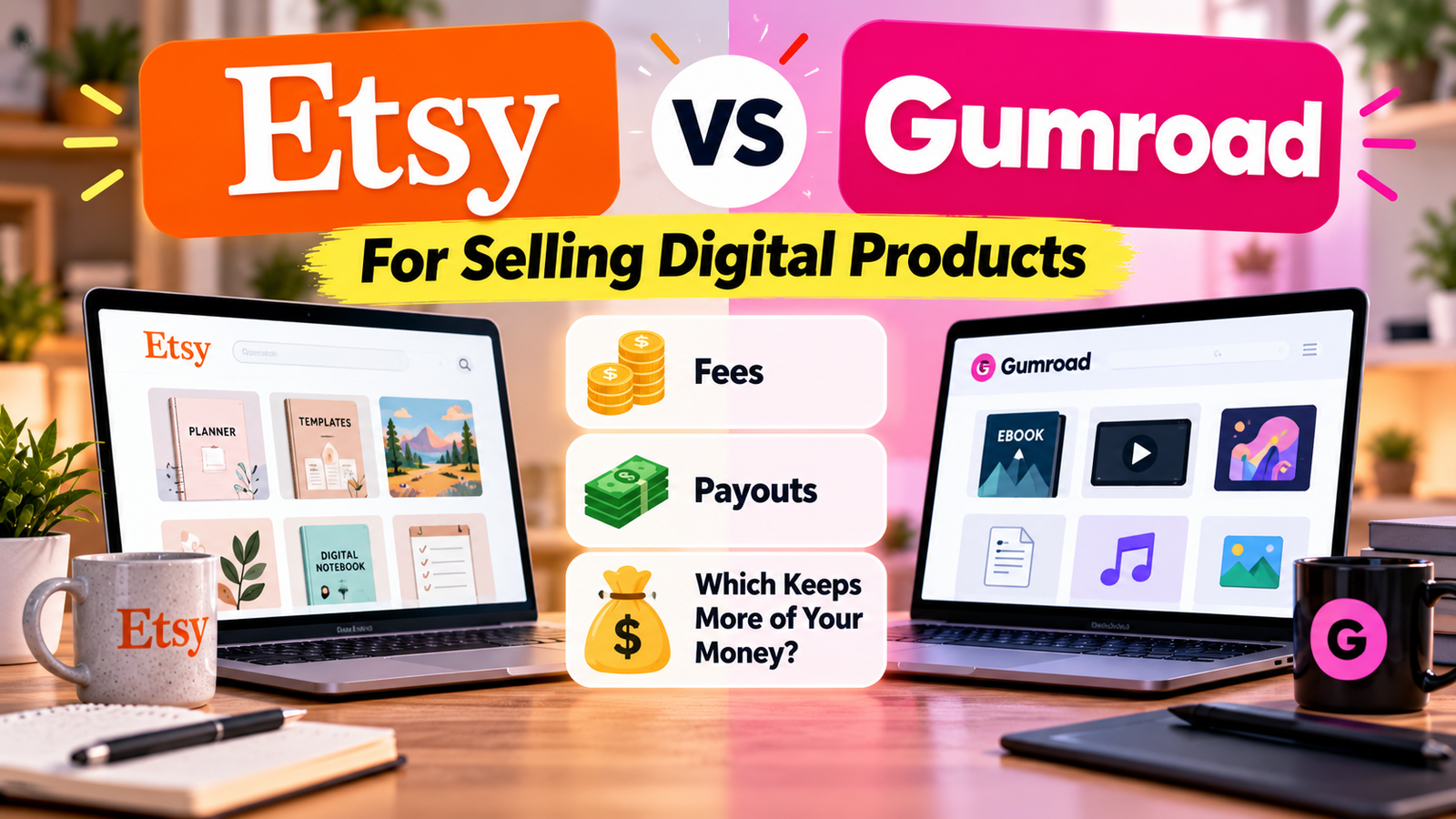
Last updated: October 9, 2026. Fees and policies below were reported by seller guides and the platforms’ own help pages in 2026 and change often and vary by country. Always check Etsy’s and Gumroad’s current fee pages before you decide. This guide is general information, not financial or tax advice.
Introduction: Which Platform Lets You Keep More of Your Money?
If you sell digital products such as printables, templates, planners, ebooks or presets, two names come up again and again: Etsy and Gumroad. Etsy is a huge marketplace where shoppers already search for products. Gumroad is a creator platform where you bring your own audience. Their fee structures are very different, so the answer to ‘which keeps more of my money’ depends on your price, your volume and where your customers come from.
This guide breaks down every fee, with worked examples at four price points, compares payouts, traffic, control of customers and policies, and gives a simple way to choose.
Quick Answer
- Per sale, Etsy usually costs less than Gumroad on direct sales, because Etsy’s fees are about 9.5% plus $0.45 in typical US cases, while Gumroad’s are about 12.9% plus $0.80 once card processing is added.
- Etsy gives you traffic; Gumroad does not. If nobody knows your shop, Etsy’s built-in search can be worth the fee.
- Gumroad gives you the customer relationship and more flexibility, such as pay-what-you-want and memberships.
- Watch the extras: Etsy Offsite Ads can add 12% to 15% on some sales, and Gumroad’s Discover marketplace takes a much bigger cut.
- Many sellers use both: Etsy to find new customers, Gumroad (or their own site) for returning customers and email subscribers.
Fee Breakdown at a Glance
| Fee | Etsy | Gumroad |
|---|---|---|
| Listing fee | $0.20 per listing, renewed every 4 months or when it sells | None |
| Platform or transaction fee | 6.5% of the item price | 10% plus $0.50 per direct sale (older articles describe a flat 10%) |
| Payment processing | About 3% plus $0.25 in the US; varies by country | About 2.9% plus $0.30, charged on top |
| Marketplace or ad fee | Offsite Ads: reported at 12% to 15% of the order, only when a sale comes from those ads and mandatory above a yearly sales level | Discover marketplace: reported 30% flat, processing included, only for sales Gumroad finds for you |
| Monthly fee | None for a standard shop | None |
| Setup fee | Etsy may charge a one-time setup fee when you open a shop; check at sign-up | None |
Note: Gumroad changed its pricing in 2025, and many 2026 articles still show an older flat 10%. Use the platform’s own pricing page as the final word.
What You Keep: Worked Examples
The numbers below use the typical US fees above for direct sales (no ads). Etsy: $0.20 listing + 6.5% + 3% + $0.25. Gumroad: 10% + $0.50 + 2.9% + $0.30. Real results vary by country and tax.
| Sale price | Etsy fees | You keep on Etsy | Gumroad fees | You keep on Gumroad | Difference in favor of Etsy |
|---|---|---|---|---|---|
| $10 | $1.40 (14.0%) | $8.60 | $2.09 (20.9%) | $7.91 | $0.69 |
| $25 | $2.83 (11.3%) | $22.17 | $4.03 (16.1%) | $20.97 | $1.20 |
| $50 | $5.20 (10.4%) | $44.80 | $7.25 (14.5%) | $42.75 | $2.05 |
| $100 | $9.95 (10.0%) | $90.05 | $13.70 (13.7%) | $86.30 | $3.75 |
At low prices, fixed fees weigh heavily. A $10 product on Gumroad loses about a fifth of its price to fees. Raising prices or selling bundles can improve your margin on either platform.
When the extra fees apply: a $25 sale
| Scenario | Total fees | You keep |
|---|---|---|
| Etsy, direct sale | About $2.83 | About $22.17 |
| Etsy, sale from Offsite Ads (15% of order added) | About $6.58 | About $18.43 |
| Gumroad, direct sale | About $4.03 | About $20.97 |
| Gumroad, sale found through Discover (30%) | $7.50 | $17.50 |
| Your own website with a payment processor (about 2.9% plus $0.30) | About $1.03 | About $23.98 |
The own-website figure leaves out hosting, tools and marketing, so it is not free. It shows how much of the fee is the platform itself.
Monthly example: 100 sales of a $20 product
| Etsy | Gumroad | |
|---|---|---|
| Fee per sale | $2.35 | $3.38 |
| Fees on 100 sales | $235 | $338 |
| You keep | $1,765 | $1,662 |
| Extra risks | Offsite Ads fee on some orders | Fee jumps to 30% on Discover sales |
Traffic and Customers
| Factor | Etsy | Gumroad |
|---|---|---|
| Built-in traffic | Large marketplace with many active buyers searching every day | Limited; you usually bring your own audience |
| Who owns the customer relationship | Etsy controls much of it, and buyer email access is limited | You can usually contact your buyers and build an email list |
| Competition | High; thousands of similar listings | Lower on-platform competition, but you must market yourself |
| Best for | Printables, planners, templates, wedding and party files and other things shoppers search for | Ebooks, courses, presets, software, memberships and products sold to an existing audience |
| Time to first sale | Can be quick if your listing ranks and fits what people search | Can be slow without a following |
Payouts and Taxes
Payout timing, minimums and methods differ by country, account age and payment method, and both platforms can place holds on new accounts. Check each platform’s current payout policy before you launch.
| Topic | What to check on Etsy | What to check on Gumroad |
|---|---|---|
| Payout schedule | Deposit schedule and any new-seller reserve | Payout frequency and minimum balance |
| Payout method | Bank account availability in your country | Bank and PayPal options in your country |
| Currency | Currency conversion fees can apply | Currency and conversion handling |
| Sales tax and VAT | Etsy collects and remits tax in many places | Check how Gumroad handles tax in your region |
| Your own income tax | You are still responsible for reporting income | You are still responsible for reporting income |
Speak to an accountant or your local tax office about how to report digital product income in your country.
Features and Flexibility
| Feature | Etsy | Gumroad |
|---|---|---|
| Digital downloads | Yes, with file limits per listing | Yes, with large file support |
| Pay what you want | Not a standard feature | Yes |
| Subscriptions and memberships | No | Yes |
| Discount codes | Yes | Yes |
| Affiliate program for your products | No | Yes, built in |
| Custom branding and checkout | Limited to your Etsy shop | More control over product pages |
| Product types allowed | Subject to Etsy’s policies on what can be sold | Wide range, within Gumroad’s rules |
Policy and Account Risk
- Etsy policies: Etsy has rules about what can be sold, including requirements around original designs, use of AI tools and intellectual property. Read the seller policy before you invest time.
- Account suspensions can happen on either platform. Keep your files backed up and your customer list somewhere you control.
- Copyright and licenses: do not sell artwork, fonts or templates you do not have rights to. Clearly state what buyers can and cannot do with your files.
- Fee and rule changes happen without much warning. Do not build your whole business on one platform.
Which Platform Should You Choose?
| If you… | Better starting point | Why |
|---|---|---|
| Have no audience and sell printables, planners or templates | Etsy | Built-in search can bring first customers |
| Already have an email list or social following | Gumroad or your own site | You own the customer relationship and avoid marketplace competition |
| Sell low-priced items under $10 | Etsy, or bundle products | Fixed fees hurt less, but check Offsite Ads |
| Sell courses, memberships or software | Gumroad or another creator platform | Features fit these products better |
| Want a simple setup with minimal tools | Gumroad | Quick to launch |
| Want the most control and lowest long-term fees | Your own website with a payment processor | You pay mainly processing fees but handle marketing and tax setup |
Other Options Worth Comparing
- Payhip: reported to charge about 5% on a free plan plus processing, with no marketplace traffic.
- Shopify or your own site: monthly costs and setup work, but more control.
- Ko-fi, Lemon Squeezy and similar tools: fees and features vary, so compare pricing pages.
Treat these as starting points for research. Fees and features change, so check each pricing page.
A Simple Plan for a New Digital Seller
- Pick one product that solves a clear problem and test it with a few people.
- Choose a platform using the tables above.
- Price with fees in mind. Use the fee tables to check your margin at your price.
- Create a clear listing with previews, file details, license terms and a helpful description.
- Collect emails where you can, so you are not dependent on one platform.
- Track your real numbers: sales, fees, refunds and payout timing.
- Review after 90 days and decide whether to add a second platform.
Common Mistakes to Avoid
- Choosing a platform based on one headline fee and ignoring processing, ads and fixed fees.
- Pricing too low, so fees take a large share.
- Ignoring policy rules, especially for AI-generated content and licensed material.
- Relying on a single platform for all your customers.
- Forgetting taxes and currency conversion.
- Not backing up product files and customer data.
Frequently Asked Questions
Is Etsy cheaper than Gumroad?
On direct sales in typical US conditions, usually yes. But Etsy Offsite Ads and Gumroad Discover can change the numbers for some sales.
Does Gumroad have a monthly fee?
No. It takes a percentage and a fixed amount from each sale, plus payment processing, according to current reports.
Can I sell the same product on both?
In most cases yes, if the product is yours and you follow each platform’s rules. Use clear license terms.
Which is better for beginners?
Etsy can help beginners find buyers through search. Gumroad is easier if you already have people to send there.
What about Offsite Ads on Etsy?
If a customer clicks one of Etsy’s off-platform ads and buys, Etsy charges an extra percentage of the order. Check your shop settings and Etsy’s policy to see what applies to you.
Update Log
| Date | Update |
|---|---|
| October 9, 2026 | First version using 2026 seller fee guides and platform fee descriptions. Please verify current fees before deciding. |
Sources and Official Links
Related Guides
Looking for more ideas? Read 10 low-investment business ideas for 2026 or 20 cheap hobbies you can start at home.



Leave a Reply