Last updated: October 2026. This is general parenting information, not medical or professional advice. Every child is different, and your school’s homework policy comes first. If you are worried about your child’s attention, learning or wellbeing, talk to their teacher or doctor.
Introduction: Why Homework Time Becomes a Battle
Many parents know the scene: your child sits down to do homework and ten minutes later they are drawing, snacking or asking to go to the bathroom for the third time. Homework time can be the hardest part of the day for children and parents alike.
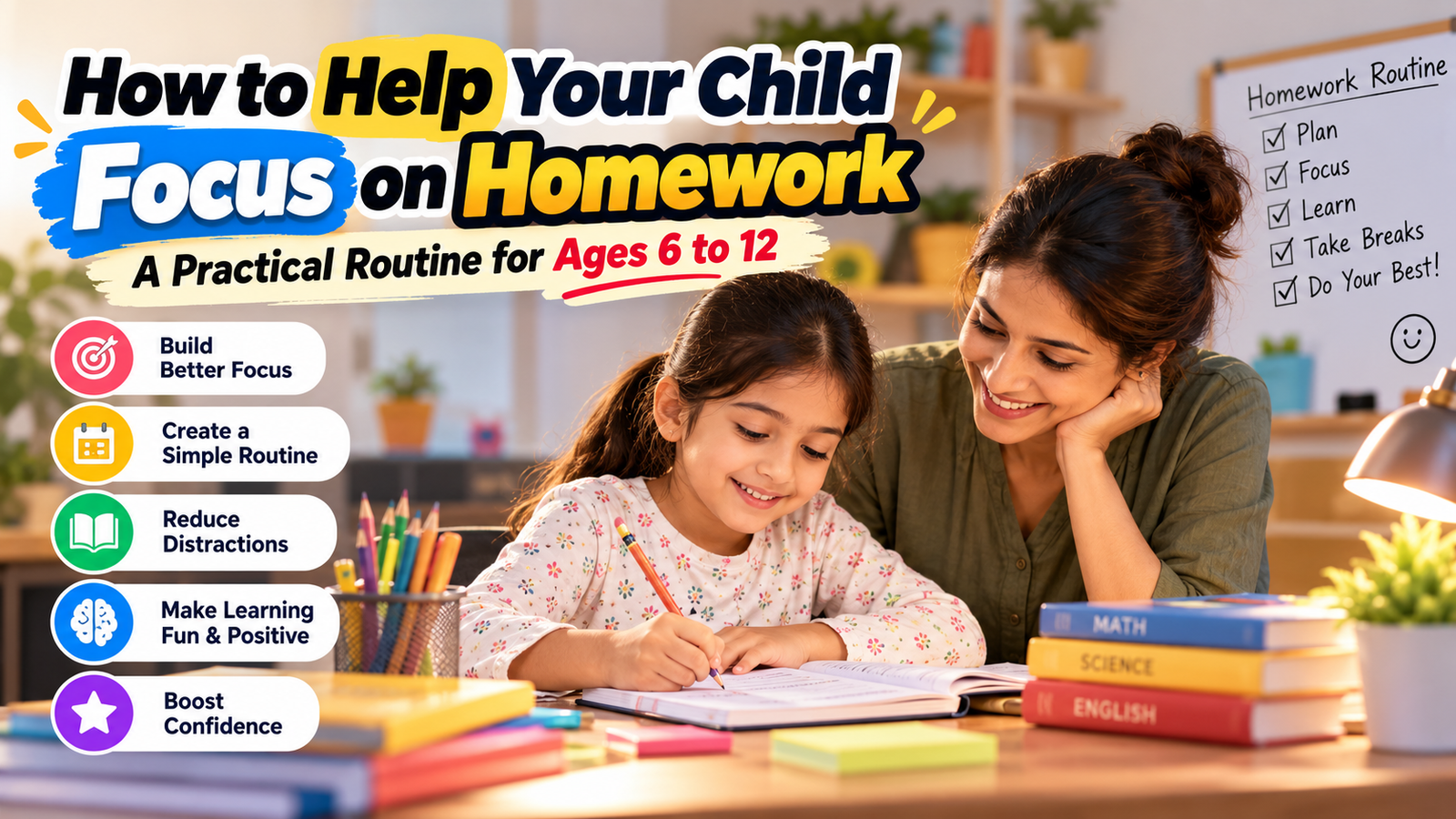
This guide gives you a practical routine for ages 6 to 12, a table of common reasons children struggle to focus, scripts for what to say, an example evening schedule and advice on when to talk to the teacher or a professional.
Quick Answer
- Give a break first. A snack and 15 to 20 minutes of movement after school helps most children settle.
- Use the same time and place every day, so homework becomes a habit, not a negotiation.
- Work in short blocks with a timer, followed by short breaks.
- Remove distractions. Phones, tablets and the TV stay away from the homework space.
- Stay nearby but do not do it for them. Your job is to support, not to complete the work.
- Talk to the teacher if homework regularly takes much longer than expected or your child is very distressed.
Why Children Struggle to Focus on Homework
Before you change the routine, it helps to understand what is really going on. Often the problem is not laziness.
| Possible reason | What it looks like | What to try |
|---|---|---|
| Tired or hungry | Slumped posture, irritability, giving up fast | Snack, water and a short break before starting; check sleep routine |
| Needs to move after a long school day | Fidgeting, getting up, being silly | 15 to 20 minutes of outdoor play or a walk before homework |
| Task feels too hard | Avoidance, crying, saying I cannot | Start with a small step together; ask the teacher if it is too advanced |
| Task feels boring or too easy | Rushing, careless mistakes, complaining | Use a timer and short challenges; mention it to the teacher |
| Distractions nearby | Looking at screens, siblings or noise | Quiet space, devices out of sight, headphones if helpful |
| Unclear instructions | Not starting, asking the same question | Read the instructions aloud together and ask your child to explain them |
| Worry or perfectionism | Rubbing out, tears, saying they will fail | Praise effort, normalize mistakes, break work into steps |
Attention difficulties can have many causes, including sleep, stress, hearing or vision problems, learning differences and other conditions. If focus problems are strong, long-lasting and happen at school and home, speak to the teacher and your child’s doctor. Do not try to diagnose it yourself.
Set Up the Homework Space
- Choose a quiet, well-lit spot with a flat surface, such as a table, not the sofa or bed.
- Keep supplies in a small box: pencils, eraser, ruler, paper, scissors, glue.
- Put a visible clock or timer on the table.
- Keep water and a snack nearby, so nobody needs to leave.
- Move phones, tablets and the TV out of the room or turn them off.
- Keep the space tidy, with only the current task on the table.
How Long Should Homework Take?
A commonly cited guideline, supported by education groups in the United States, is about 10 minutes per grade level per night. That would mean around 10 minutes in grade 1 and 60 minutes in grade 6. Your school may set different rules, so follow their guidance and speak to the teacher if the time is much longer.
| Age | Typical work block | Break | Your role |
|---|---|---|---|
| 6 to 7 | 10 to 15 minutes, usually one block | Movement break afterwards | Sit nearby, read instructions aloud, praise effort |
| 8 to 9 | 15 to 20 minutes, up to two blocks | 5 minutes between blocks | Stay in the room, help them plan, check at the end |
| 10 to 12 | 20 to 25 minutes, two or three blocks | 5 to 10 minutes between blocks | Be available, let them lead, check the plan and finished work |
A Step-by-Step Homework Routine
- Arrive and reset (15 to 20 minutes). Snack, water and some movement.
- Make a plan (2 minutes). List tasks on paper and tick them off.
- Start the timer. Begin with the task your child chooses, or the hardest if they are fresh.
- Work for one block. Stay close but let your child do it.
- Take a short break. Stand up, stretch, drink water. Avoid screens.
- Do the next block. Repeat until finished.
- Check and pack. Put finished work in the school bag, then end with praise for effort.
Example: A 45-Minute Evening for a Fourth-Grader (Age 9)
| Time | Activity |
|---|---|
| 4:00 pm | Snack and water |
| 4:10 pm | Outdoor play or a walk |
| 4:30 pm | Plan the tasks together |
| 4:35 pm | Block 1: math worksheet (20 minutes) |
| 4:55 pm | Break: stretch and drink water (5 minutes) |
| 5:00 pm | Block 2: reading and spelling (20 minutes) |
| 5:20 pm | Pack the bag and finish |
What to Say: Scripts for Common Moments
| Situation | Instead of saying | Try saying |
|---|---|---|
| Child refuses to start | You never listen, sit down now | Let us look at it together. What is the first small step? |
| Child says it is too hard | It is easy, just try | This looks tricky. What part do you understand so far? |
| Child makes a mistake | That is wrong, do it again | Good try. Can you spot where it went off track? |
| Child is distracted | Focus, stop messing around | Let us set a 15-minute timer, then you can have a break |
| Child gets upset | Stop crying, it is only homework | You seem upset. Let us take a short break and try again |
Managing Screens and Distractions
- Keep phones and tablets away during homework unless the task needs one.
- If a computer is needed, keep it in a shared space and consider website blockers.
- Turn off notifications on any device being used.
- Agree on screen time after homework, so it is a reward and not a battle.
- Keep siblings’ noise in check by giving each child a different time or space.
When to Talk to the Teacher or a Professional
- Homework regularly takes much longer than the school suggests.
- Your child is often in tears or very anxious about school work.
- They seem to struggle with reading, writing or numbers more than classmates.
- You suspect vision or hearing problems, such as squinting or asking for repeats.
- Focus problems appear at school and at home and do not improve with routine.
- Your child has big changes in mood, sleep or appetite.
Start with the class teacher. They can tell you what they see at school. Your child’s doctor can check for health causes and advise on next steps.
Common Mistakes to Avoid
- Doing the work for your child to end the argument.
- Starting right after school with no break.
- Letting homework go late into the evening when everyone is tired.
- Praising results only, not effort.
- Comparing your child with siblings or classmates.
- Changing the routine every few days.
Frequently Asked Questions
How long should my child spend on homework?
A common guideline is about 10 minutes per grade level, but follow your school’s advice and speak to the teacher if it takes far longer.
Should I sit with my child during homework?
For younger children, yes, nearby. For older children, stay available and check in. Support them without taking over.
Should I use rewards?
Small rewards like extra playtime can help in the short term. Praise effort and progress too, so your child learns to value the work itself.
What if my child hates homework no matter what?
Try one change at a time, such as the time, place or length of blocks. If nothing helps over a few weeks, talk to the teacher.
Can too much homework be a problem?
Yes. If it takes away from sleep, play and family time, raise it with the school.
Sources and Further Reading
- HealthyChildren.org (American Academy of Pediatrics parenting information)
- National Education Association (education guidance)
- Centers for Disease Control and Prevention (child development)
Related Guides
A short family walk makes a good break before homework. See our 30 day walking plan for beginners.



Leave a Reply