Last updated: October 9, 2026. This guide is general nutrition information, not medical advice. Protein needs depend on age, health, pregnancy, activity and medical conditions. If you have kidney disease, a metabolic condition or an eating disorder, or you are pregnant, a child or an older adult with health concerns, ask your doctor or a registered dietitian before changing your protein intake.
Introduction: What Is the New 1.2 to 1.6 g/kg Protein Guideline?
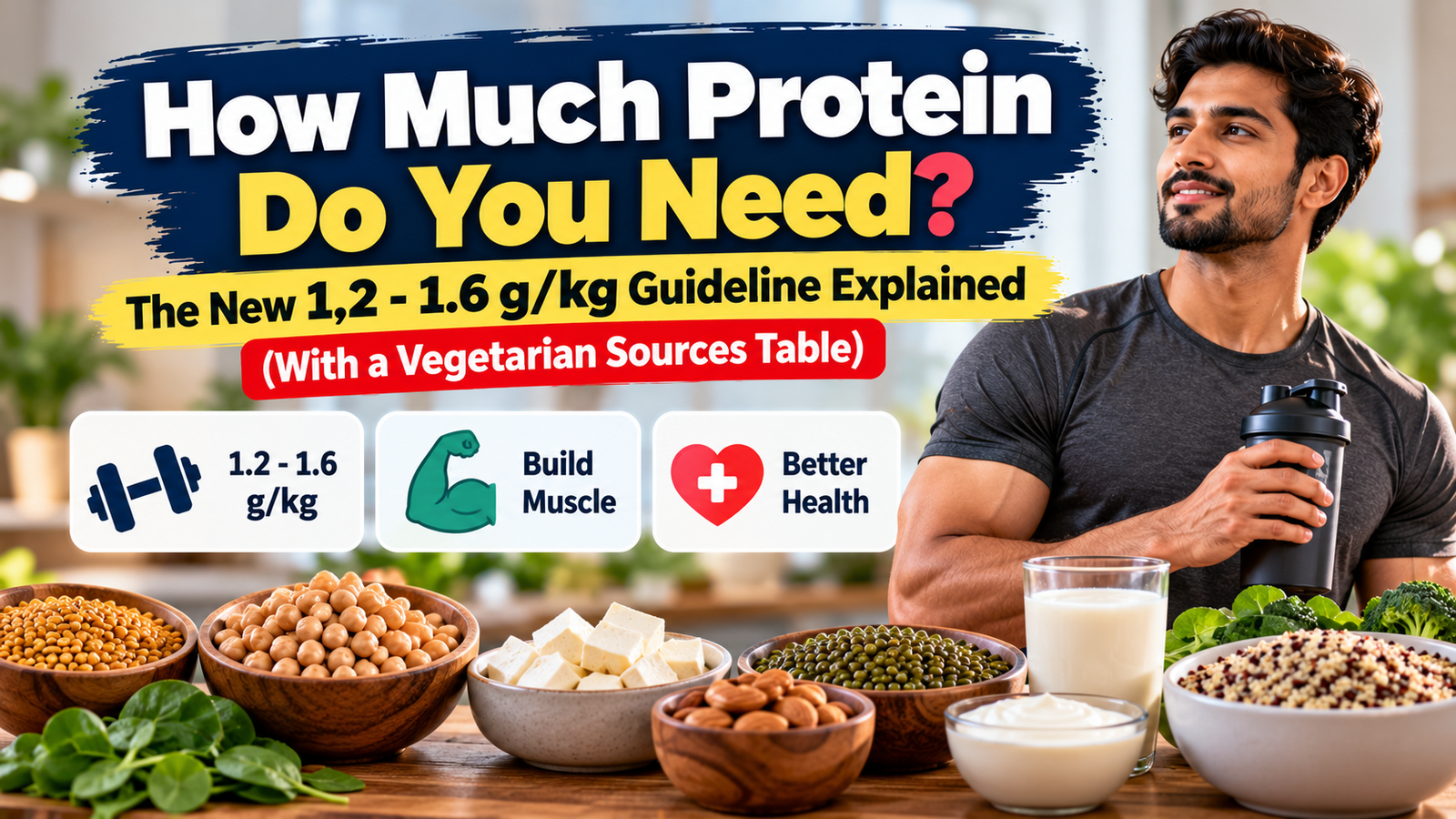
In January 2026, the US government released the 2025-2030 Dietary Guidelines for Americans. One headline change was a protein goal of 1.2 to 1.6 grams of protein per kilogram of body weight per day. For decades, the official Recommended Dietary Allowance (RDA) for adults has been 0.8 g/kg, so the new range sounds much higher.
The change has also drawn debate among nutrition experts. This guide explains what the numbers mean, how to calculate your own range, which foods count, how to reach your goal as a vegetarian, and who should be careful. You will also find tables for body weight, serving sizes and a sample day.
Quick Answer
- New guideline: 1.2 to 1.6 g of protein per kg of body weight per day, as part of a pattern that emphasizes whole foods.
- Old RDA: 0.8 g/kg per day, which was set to prevent deficiency in most healthy adults, not to be an ideal target.
- Example: a 70 kg adult would aim for about 84 to 112 g a day under the new range, compared with 56 g under the RDA.
- Many people already eat near the lower end, according to experts quoted in news coverage.
- You do not need to track every gram. Eating protein at each meal from varied foods usually gets you there.
- Check with a doctor first if you have kidney disease or other medical conditions.
RDA vs the New Range: What Is the Difference?
| RDA (long-standing) | 2025-2030 Dietary Guidelines | |
|---|---|---|
| Number | 0.8 g per kg per day | 1.2 to 1.6 g per kg per day |
| What it aims for | Prevent deficiency in nearly all healthy adults | Support a healthy dietary pattern, muscle and fullness |
| Who set it | US and Canadian nutrition authorities (Dietary Reference Intakes) | US Department of Agriculture and Department of Health and Human Services |
| How it was received | Widely used as the minimum | Praised by some for emphasizing protein foods; questioned by others who say most people do not need that much |
Some experts note that the 1.2 to 1.6 range is 50 to 100 percent higher than the RDA, and that many Americans already eat close to 1.2 g/kg. Others point out that higher protein can be useful for strength training, weight management and older adults. The most sensible reading is that the range is a goal to aim for within a balanced diet, not a reason to eat huge amounts.
How to Calculate Your Protein Range
- Find your weight in kilograms. If you know pounds, divide by 2.2.
- Multiply by 1.2 to get the lower end of your range.
- Multiply by 1.6 to get the upper end.
- Compare with 0.8 g/kg (the RDA) to see the minimum.
| Body weight | RDA (0.8 g/kg) | New range (1.2 to 1.6 g/kg) |
|---|---|---|
| 50 kg (110 lb) | 40 g | 60 to 80 g |
| 60 kg (132 lb) | 48 g | 72 to 96 g |
| 70 kg (154 lb) | 56 g | 84 to 112 g |
| 80 kg (176 lb) | 64 g | 96 to 128 g |
| 90 kg (198 lb) | 72 g | 108 to 144 g |
If you are trying to lose weight, many dietitians suggest calculating from a healthy or goal weight with your doctor’s guidance, not from a very high current weight. Ask a professional for advice that fits you.
What Counts as One Serving of Protein?
Government nutrition guidance gives these examples of roughly one serving of protein foods. Protein content varies by food and brand, so always check labels.
| Food | Serving |
|---|---|
| Cooked meat, poultry or seafood | 3 ounces (85 g) |
| Eggs | 1 egg |
| Tofu, tempeh or seitan | 3 ounces (85 g) |
| Cooked beans or lentils | 1/2 cup |
| Peanut butter | 2 tablespoons |
| Nuts or seeds | 1 ounce (28 g) |
Vegetarian Protein Sources Table
Values are approximate and vary by brand, preparation and type. Check food labels or the USDA FoodData Central database for exact numbers.
| Food | Typical portion | Approximate protein | Notes |
|---|---|---|---|
| Cooked lentils | 1 cup | About 18 g | High in fiber and iron |
| Cooked chickpeas | 1 cup | About 15 g | Good in curries, salads and hummus |
| Cooked black beans or kidney beans | 1 cup | About 15 g | Budget-friendly |
| Firm tofu | 1/2 cup | About 10 to 20 g depending on type | Soy is a complete protein |
| Tempeh | 100 g | About 19 g | Fermented soy with a firm texture |
| Edamame (cooked, shelled) | 1 cup | About 17 to 18 g | Good snack or salad topper |
| Seitan | 100 g | About 20 to 25 g | Made from wheat gluten; avoid if you have celiac disease or gluten sensitivity |
| Paneer | 100 g | About 18 to 20 g | A dairy-based protein popular in South Asian cooking |
| Greek yogurt (plain) | 170 g (about 3/4 cup) | About 15 to 17 g | Choose unsweetened |
| Cottage cheese | 1/2 cup | About 12 to 14 g | Check the salt content |
| Eggs | 1 large egg | About 6 g | Complete protein |
| Milk | 1 cup | About 8 g | Fortified milk also gives calcium and vitamin D |
| Cooked quinoa | 1 cup | About 8 g | A complete plant protein |
| Peanut butter | 2 tablespoons | About 7 to 8 g | Calorie-dense; watch added sugar |
| Pumpkin seeds | 1 ounce (28 g) | About 7 to 9 g | Good for snacks and salads |
| Almonds | 1 ounce (28 g) | About 6 g | Also provide healthy fats |
| Whole-wheat bread | 1 slice | About 3 to 4 g | Adds up across the day |
| Rolled oats (dry) | 1/2 cup | About 5 g | Pair with milk or yogurt |
Sample Vegetarian Day (About 100 g of Protein)
This example is for a person aiming for roughly 84 to 112 g a day. Amounts are approximate.
| Meal | Foods | Approximate protein |
|---|---|---|
| Breakfast | 2 eggs, 2 slices whole-wheat toast, 1 cup milk | About 28 g |
| Snack | Greek yogurt (170 g) with 1 ounce pumpkin seeds | About 24 g |
| Lunch | 1 cup cooked lentils with 1 cup cooked quinoa and vegetables | About 26 g |
| Dinner | 100 g paneer or tofu with 1/2 cup chickpeas and vegetables | About 25 g |
| Total | About 100 g |
Our guide to high protein vegetarian meal prep shows how to cook these meals in advance.
Do Vegetarians and Vegans Get Enough Protein?
- Yes, with variety. Beans, lentils, soy foods, whole grains, nuts and seeds all contribute.
- Soy and quinoa are complete proteins. Other plant foods can be mixed across the day, and you do not need to combine them in the same meal.
- Vegans may need to eat more total plant protein, because plant proteins are slightly less digestible on average.
- Spread protein across meals, often about 20 to 30 g per meal, which many people find easier than one big serving.
- Watch other nutrients, such as vitamin B12, iron, zinc and omega-3, especially on a vegan diet. Ask a dietitian.
Who Needs Different Advice?
| Group | What to know | Who to ask |
|---|---|---|
| Healthy adults who are not very active | The RDA of 0.8 g/kg is the minimum; many people eat more naturally | A registered dietitian if unsure |
| People doing regular strength training | Higher intakes within the 1.2 to 1.6 range, and sometimes more, are common in sports nutrition guidance | A sports dietitian |
| Older adults | Protein helps preserve muscle, and some guidance suggests at least 1.0 to 1.2 g/kg | A doctor or dietitian, especially with health conditions |
| People with kidney disease | May need to limit protein. Do not increase intake without advice. | A kidney specialist or renal dietitian |
| Pregnant or breastfeeding people | Needs are higher, but should be personalized | A doctor, midwife or dietitian |
| Children and teenagers | Needs are set by age and growth; the adult range may not apply | A pediatrician or dietitian |
| People with a history of disordered eating | Tracking grams can be harmful | A healthcare professional |
Myths and Facts
| Myth | Fact |
|---|---|
| You must hit 1.6 g/kg every day | The range is a goal, not a pass or fail test |
| More protein always builds more muscle | Strength training and total calories matter too, and benefits level off |
| Plant protein is not enough | Varied plant foods can meet needs for most people |
| Protein shakes are necessary | Most people can reach their goal with food, though shakes can be convenient |
| High protein damages healthy kidneys | Evidence in healthy people is limited, but people with kidney disease should get medical advice |
| Protein melts fat | Protein can help with fullness and muscle, but weight depends on total diet and activity |
Tips to Reach Your Goal Without Tracking Everything
- Anchor each meal with a protein food: eggs, yogurt, lentils, tofu, paneer or beans.
- Keep easy snacks such as yogurt, nuts, hummus or boiled eggs.
- Add beans or lentils to soups, salads and curries.
- Choose whole foods first, and limit highly processed products with added sugar.
- Check labels on bars and shakes for added sugar.
- Check in with a dietitian if you are unsure or have health conditions.
Common Mistakes to Avoid
- Jumping to very high protein intakes without advice.
- Ignoring fiber, fruit and vegetables while eating more protein.
- Relying on expensive supplements when food would do.
- Counting grams obsessively.
- Assuming your needs are the same as an athlete’s.
- Forgetting to drink water and eat enough overall calories.
Frequently Asked Questions
Is 1.2 to 1.6 g/kg the new RDA?
No. The RDA is still 0.8 g/kg. The 1.2 to 1.6 range is a goal in the 2025-2030 Dietary Guidelines for Americans.
How much protein is 1.6 g/kg for a 60 kg person?
About 96 g a day (60 multiplied by 1.6).
Can I get enough protein as a vegetarian?
Yes. Beans, lentils, tofu, tempeh, eggs, dairy, nuts, seeds and whole grains can all contribute. See the table above.
Should I use the guideline to lose weight?
Higher protein can help you feel full and protect muscle during weight loss, but results depend on your whole diet. Ask a doctor or dietitian for a plan.
Do I need protein powder?
Not usually. It can be convenient, but whole foods work well. Check labels for added sugar and look for products tested by a third party.
Update Log
| Date | Update |
|---|---|
| October 9, 2026 | First version based on the 2025-2030 Dietary Guidelines for Americans and public health nutrition sources |
Sources and Official Links
- Dietary Guidelines for Americans
- MedlinePlus: Dietary Guidelines for Americans 2025-2030
- USDA FoodData Central
- FactCheck.org coverage of the protein guideline
Related Guides
Put the numbers into practice with high protein vegetarian meal prep and learn about steadier energy in our metabolic health guide.


Leave a Reply